

SQL Backup Master: Free Download, Features & Complete Guide
Protecting SQL Server databases is essential for businesses, developers, system administrators, and anyone responsible for important database information. A database may contain customer records, financial information, application data, inventory, user accounts, or other critical information that cannot easily be recreated after a failure.
SQL Backup Master 8.7.1139 is a Windows-based backup utility designed to simplify SQL Server database backup and recovery. It can automate backup jobs, store backups locally or remotely, compress backup files, encrypt backup archives, manage retention, and provide notifications when backup operations succeed or fail.
The software can be useful for both small SQL Server installations and larger environments where administrators need a consistent backup routine without manually creating backup commands for every database.
| Part | Nitroflare | Rapidgator |
| SQL Backup Master 8.7.1139 | 🔴 DOWNLOAD | 🟢 DOWNLOAD |
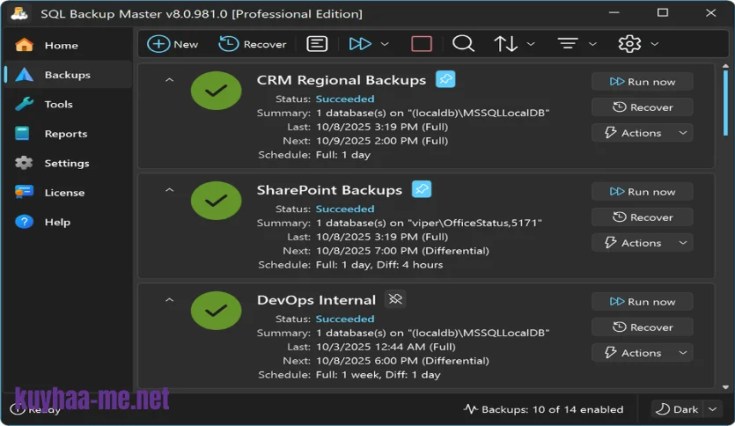
What Is SQL Backup Master?
SQL Backup Master is database backup software designed specifically for Microsoft SQL Server environments.
It provides a graphical interface for creating backup jobs instead of requiring users to manually write and maintain SQL backup scripts for common operations.
The software supports full, differential, and transaction log backups. Backup jobs can be scheduled to run automatically at selected times and intervals.
Backups can be stored in local folders, network locations, external storage, FTP servers, SFTP servers, WebDAV locations, and various cloud storage services.
The application also provides compression, encryption, automatic cleanup, notifications, logging, recovery tools, and other features designed to simplify database protection.
Why Users Search for SQL Backup Master Free Download
Many users search for a free download because they want an easy way to protect SQL Server databases without immediately purchasing a commercial backup solution.
The basic edition is available as a free option and provides several important database backup capabilities. It can be useful for individuals, developers, small businesses, and users working with SQL Server Express or other supported editions.
Before using any backup software with important production databases, it is recommended to test the backup and recovery process with non-critical data.
Is SQL Backup Master Free?
The software provides a free basic edition along with paid editions that add advanced capabilities.
The free edition supports important features such as full, differential, and transaction log backups, scheduling, compression, automatic cleanup, notifications, logging, local and network storage, and several remote storage options.
Some advanced capabilities and larger-scale scheduling options are available in paid editions.
Because the available features can change between editions and software releases, users should check the application’s current license information before choosing a version.
SQL Backup Master Free Download
The free edition can be used to create automated SQL Server backup jobs without requiring a paid license for the basic functionality.
A typical installation involves downloading the Windows installer, running the setup process, selecting the required installation options, and launching the application.
For security, users should avoid unofficial modified installers, cracked versions, and suspicious activation tools. Database backup software handles highly sensitive information, so using a trusted installation package is particularly important.
Key Features of SQL Backup Master
SQL Backup Master provides a range of features for creating and managing SQL Server backups.
Important capabilities include:
- Full database backups
- Differential backups
- Transaction log backups
- Scheduled backup jobs
- Automatic backup execution
- Local storage
- Network storage
- NAS support
- FTP support
- SFTP support
- FTPS support
- WebDAV support
- Cloud storage
- Backup compression
- AES-256 backup encryption
- Automatic backup cleanup
- Backup logging
- Email notifications
- Desktop notifications
- Webhook notifications
- Backup recovery
- Batch database restoration
- Command-line support
- Custom SQL scripts
- Custom batch scripts
- Failed backup retry
- Backup reports
SQL Server Database Backup
The main purpose of SQL Backup Master is to simplify SQL Server database backups.
Instead of manually creating backup commands every time a database needs to be protected, users can create a backup job and allow the software to execute it automatically.
A backup job can contain one or more databases, a destination, a schedule, retention settings, compression options, encryption settings, and notification preferences.
This creates a repeatable backup process that can operate without constant manual intervention.
Full Database Backups
A full backup contains the complete database information required for a database restoration.
Full backups are usually an important foundation of a SQL Server backup strategy.
Users can schedule full backups at appropriate intervals based on how frequently their database changes and how quickly they need to recover after a failure.
For smaller databases, frequent full backups may be practical. Larger databases may use full backups together with differential and transaction log backups.
Differential Backups
A differential backup stores changes made since the most recent full backup.
This can reduce the amount of data that needs to be backed up compared with creating a complete full backup every time.
Differential backups are particularly useful when databases change frequently but a full backup does not need to be created after every change.
When restoring a differential backup, the corresponding full backup is also required.
Transaction Log Backups
Transaction log backups are designed for SQL Server databases using recovery models that support them.
They can capture transactions recorded in the database log and allow administrators to restore a database to a more specific point in time when a suitable backup chain is available.
Transaction log backups can therefore be valuable for databases where minimizing potential data loss is important.
Automated Backup Scheduling
Manual backups can easily be forgotten, especially when administrators manage multiple databases.
SQL Backup Master provides scheduling functionality that allows users to define when backup jobs should run.
Schedules can be configured around specific dates, days of the week, times, and intervals.
This allows organizations to create regular backup routines without manually starting each operation.
Scheduled Backup Jobs
A backup job defines what databases should be backed up, where the files should be stored, when the job should run, and how the resulting files should be handled.
Users can configure different backup types within their backup strategy.
For example, a schedule may use regular full backups combined with more frequent differential or transaction log backups.
The exact schedule should be selected according to the database’s recovery requirements and available storage.
Backup Multiple SQL Server Databases
Administrators often need to protect more than one database.
The software allows backup jobs to target multiple databases, making it possible to manage several databases from a centralized backup configuration.
This can be particularly useful for application servers hosting separate databases for different applications, departments, or customers.
Local Backup Storage
Backups can be stored on local drives or other directly accessible storage locations.
Local backups are useful for fast recovery because they can often be accessed more quickly than remote copies.
However, storing backups only on the same physical system as the production database creates a significant risk. Hardware failure, ransomware, accidental deletion, or other disasters could affect both the original database and its backup.
For important data, an additional external or off-site copy is recommended.
Network Backup Storage
Network folders and NAS devices can provide a convenient destination for SQL Server backups.
A network-based backup can separate the backup files from the database server while still keeping them available within the organization’s infrastructure.
Administrators should ensure that the SQL Backup Master service has appropriate permissions to access the destination.
Cloud Backup Options
Cloud storage can provide an additional layer of protection by keeping database backups away from the primary server location.
Depending on the selected configuration and edition, backups can be transferred to supported cloud services and object-storage platforms.
Cloud storage can be useful for disaster recovery, remote access, geographical redundancy, and long-term backup retention.
However, administrators should consider upload bandwidth, storage costs, security, retention policies, and recovery speed before selecting a cloud destination.
FTP and SFTP Backup
FTP-based destinations can be useful when an organization already maintains a remote file server.
SFTP and FTPS provide more secure alternatives for transferring backup files.
Secure transfer protocols are particularly important when backups contain confidential customer, financial, or business information.
Backup Compression
Database backups can become large, especially when databases contain significant amounts of data.
Compression reduces the size of backup files, which can save storage space and reduce the amount of data that needs to be transferred to remote destinations.
Compressed backups can be particularly helpful when using cloud storage or network transfers.
The amount of compression achieved depends on the type and structure of the database data.
Backup Encryption and Security
Backup files may contain the same sensitive information as the original database.
For this reason, protecting backup files is just as important as protecting the production database.
The software supports encryption of compressed backup archives using AES-256 in supported configurations.
Encryption can help protect database backups if unauthorized users gain access to the storage location.
Users should also protect encryption passwords or credentials carefully because losing the required security information can make recovery difficult or impossible.
Password-Protected Backups
Password protection can add another layer of security to backup archives.
When sensitive database information is stored outside the main server, password protection and encryption can reduce the risk of unauthorized access.
Strong, unique passwords should be used and stored securely.
Backup Retention and Cleanup
Keeping every backup forever can eventually consume large amounts of storage.
SQL Backup Master provides automatic cleanup functionality that can remove older backup files according to configured retention rules.
Retention settings should be chosen carefully.
Deleting too many backups can reduce recovery options, while keeping excessive numbers of backups can increase storage requirements.
Automatic Old Backup Removal
Automatic cleanup is particularly useful for organizations that create backups every day or even several times per day.
Instead of manually deleting old files, administrators can configure a retention period.
The software can manage older backup files while protecting backup chains needed for future restoration.
This reduces routine maintenance and helps prevent backup storage from becoming unnecessarily full.
Email Notifications
Backup failures can go unnoticed if administrators do not monitor backup jobs.
Notification features can provide alerts about backup activity.
Email notifications can help administrators quickly identify failed jobs and investigate problems before a backup gap becomes a serious issue.
Desktop notifications and webhooks may also be available depending on the configuration and edition.
Backup Verification
Creating a backup is only part of a successful recovery strategy.
Administrators should periodically verify that backup files are being created correctly and that databases can actually be restored.
A backup that cannot be restored is not a reliable backup.
Testing restoration procedures is therefore an important part of database administration.
SQL Server Recovery
Recovery allows administrators to restore a database from a previously created backup.
The recovery process may involve a full backup followed by the appropriate differential and transaction log backups, depending on the backup strategy.
The software provides tools intended to simplify this process through a graphical recovery workflow.
Restoring SQL Server Databases
To restore a database, users select an available backup and provide the required restoration information.
The software can help retrieve backup files from configured storage destinations and restore supported database backups.
Administrators should be careful when restoring databases on production servers because an incorrect restoration can overwrite or replace important data.
Database Recovery Workflow
A typical recovery workflow includes:
- Identify the required recovery point.
- Locate the appropriate full backup.
- Identify the required differential backup if applicable.
- Locate the required transaction log backups.
- Verify that the backup chain is complete.
- Start the restoration process.
- Verify the restored database.
- Check applications and database connections.
The exact process depends on the SQL Server recovery model and backup strategy.
Backup Management and Monitoring
Backup management becomes increasingly important as the number of databases grows.
The software provides backup logs and reporting features that can help administrators monitor backup activity.
Logs can help identify problems such as connection failures, storage errors, permission problems, or failed uploads.
Regularly reviewing backup logs can help identify problems before they become serious.
User Interface and Ease of Use
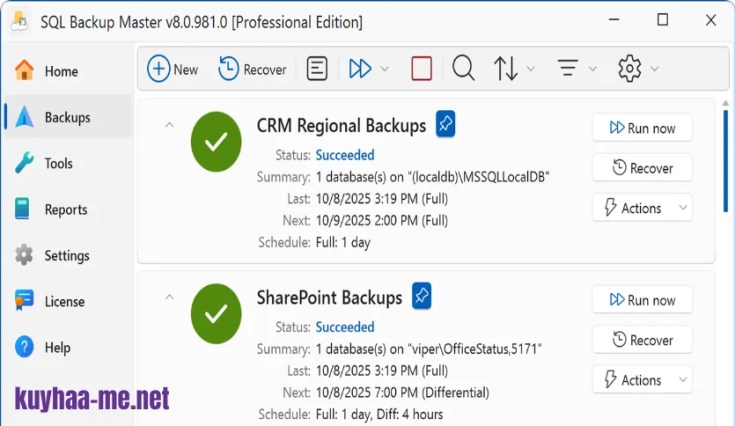
SQL Backup Master is designed around a graphical interface rather than requiring administrators to manually create every backup command.
The main workflow revolves around creating backup jobs, selecting databases, configuring destinations, setting schedules, and monitoring results.
This can make database backup management easier for users who are comfortable with SQL Server but do not want to maintain complex scripts for every backup task.
Performance and Resource Usage
Backup performance depends on several factors, including:
- Database size
- Storage speed
- Network bandwidth
- Compression settings
- Encryption settings
- Number of databases
- Backup destination
- SQL Server performance
- Available system resources
Local storage will often provide faster transfers than remote destinations, while cloud or network backups may take longer depending on bandwidth.
Administrators should test backup performance during normal operating conditions.
Supported SQL Server Versions
The software supports a broad range of Microsoft SQL Server editions and versions.
Current compatibility includes SQL Server versions extending from older releases through modern supported versions.
Compatibility can change as new database versions are introduced, so administrators should verify support before deploying the software in a production environment.
Windows Compatibility and System Requirements
SQL Backup Master is designed for Windows environments and can be used with supported versions of Windows desktop and Windows Server.
Current supported Windows platforms include modern versions such as Windows 8.1, Windows 10, Windows 11, and supported Windows Server releases.
The computer should also have sufficient storage for temporary files and database backups.
How to Install SQL Backup Master
Installing the software is generally straightforward.
First, download the appropriate Windows installer.
Run the installer and follow the setup instructions.
After installation, launch the application and connect it to the SQL Server instance that contains the databases you want to protect.
Before creating production backup jobs, verify that the application has the necessary permissions to access SQL Server and the selected backup destinations.
How to Configure a SQL Server Backup
Start by creating a new backup job.
Select the SQL Server instance and identify the databases that need protection.
Next, select the backup destination.
Configure compression, encryption, retention, notifications, and other available options.
Finally, configure the schedule and save the backup job.
Run an initial backup manually to confirm that everything works correctly before depending on the scheduled job.
How to Create a Backup Job
A typical backup job can be created by following these steps:
- Open the application.
- Create a new backup job.
- Select the SQL Server instance.
- Select one or more databases.
- Choose the backup type.
- Select a storage destination.
- Configure compression.
- Configure encryption if required.
- Set retention rules.
- Configure notifications.
- Set the schedule.
- Save the job.
- Run a test backup.
How to Schedule Automatic Backups
Automatic scheduling is one of the most useful features.
Choose the required backup job and open its scheduling options.
Select the start date and time, frequency, days, and other available scheduling settings.
A practical strategy might use a full backup periodically, differential backups more frequently, and transaction log backups at shorter intervals when the database recovery model supports them.
The correct schedule depends on how much data the organization can afford to lose and how quickly the database needs to be recovered.
How to Restore a Database
To restore a database:
- Open the recovery section.
- Locate the required backup.
- Select the database.
- Identify the appropriate restore point.
- Select the destination SQL Server instance.
- Configure restoration options.
- Start the restoration.
- Verify the database after completion.
Always test restoration procedures before an emergency occurs.
How to Manage Backup Storage
Backup storage should be monitored regularly.
Check available disk space, cloud storage limits, network capacity, and retention settings.
If backups are accumulating faster than expected, review the backup schedule and retention policy.
Using compression and automatic cleanup can help control storage usage.
For critical systems, maintaining multiple backup destinations can provide additional protection against storage failures.
SQL Backup Master for Beginners
Beginners can benefit from the graphical approach to database backup management.
Instead of writing complex scripts, they can create backup jobs through a guided interface.
However, database administrators should still understand the difference between full, differential, and transaction log backups before creating a production backup strategy.
Learning how restoration works is equally important.
SQL Backup Master for Database Administrators
Database administrators can use the software to manage recurring backup operations across multiple databases.
Scheduling, logging, notifications, command-line functionality, custom scripts, retention management, and multiple storage destinations can help reduce manual administration.
Advanced users can also integrate backup tasks into broader IT workflows.
SQL Backup Master for Small Businesses
Small businesses may not have a dedicated database administrator.
An automated backup application can help create a consistent backup process without requiring staff to manually start backups every day.
The free edition can also provide a starting point for organizations with modest backup requirements.
SQL Backup Master for IT Professionals
IT professionals can use the application as part of a broader data protection strategy.
Remote storage, encryption, compression, scheduling, monitoring, reports, and automated cleanup can help create a structured backup environment.
However, the software should be considered one component of a larger disaster recovery plan rather than the entire strategy.
Advantages of SQL Backup Master
The main advantages include:
- Free basic edition
- Full database backups
- Differential backups
- Transaction log backups
- Automated scheduling
- Multiple storage destinations
- Cloud backup support
- Network storage support
- Compression
- AES-256 encryption
- Automatic cleanup
- Backup notifications
- Logging and reports
- Recovery functionality
- Batch restoration
- Command-line support
- Custom SQL and batch scripts
Limitations of SQL Backup Master
There are also some limitations to consider.
The software is primarily intended for Windows environments.
Some advanced features are restricted to paid editions.
Cloud backup also depends on the availability and performance of the selected storage provider.
Most importantly, backup software cannot replace a complete disaster recovery strategy. Organizations should maintain appropriate backup redundancy and regularly test restoration.
SQL Backup Master vs Manual SQL Server Backups
Manual SQL Server backups provide flexibility and do not require an additional graphical backup application.
However, manual processes can be difficult to maintain consistently, especially when multiple databases require regular backups.
SQL Backup Master provides a centralized interface for scheduling, storage, compression, encryption, notifications, and cleanup.
For administrators who want automation without building everything from scripts, this can be a major advantage.
SQL Backup Master vs Other Database Backup Tools
Database backup tools vary considerably in complexity and price.
Some enterprise solutions provide advanced disaster recovery, centralized management, monitoring, and integration with large IT environments.
Other tools focus on simple database backups.
SQL Backup Master occupies a practical middle ground by providing automated SQL Server backup management with local, network, FTP, and cloud storage options.
The best solution depends on database size, recovery requirements, budget, infrastructure, and organizational needs.
Common Problems and Troubleshooting
Backup Job Fails
Check the SQL Server connection, database permissions, storage destination, available disk space, and backup job logs.
Backup Destination Is Unavailable
Verify network connectivity and credentials. For cloud destinations, check authentication and service availability.
Backup Storage Is Full
Review retention settings, remove unnecessary files according to your organization’s policy, and consider increasing available storage.
Scheduled Backup Does Not Run
Check the Windows service, schedule configuration, permissions, and backup job status.
Database Restore Fails
Verify that the required full backup and any dependent differential or transaction log backups are available and form a valid backup chain.
Cloud Upload Is Slow
Upload performance depends heavily on internet bandwidth, backup size, encryption and compression settings, and the remote storage service.
Email Notifications Are Not Received
Check SMTP configuration, credentials, firewall settings, spam filtering, and the notification settings of the backup job.
Safe Download and Installation Tips
Database backup software should always be downloaded from a trustworthy source.
Avoid cracked or modified versions because backup applications can have access to sensitive database information and system resources.
Before installing:
- Use a trusted installer.
- Keep Windows security features enabled.
- Avoid suspicious activation tools.
- Verify application permissions.
- Test the software with a non-critical database.
- Keep database backups separate from the production system.
- Protect backup encryption passwords.
- Regularly test restoration.
Best Practices for SQL Server Backups
A good backup strategy should consider both data protection and recovery requirements.
Useful practices include:
- Schedule backups automatically.
- Maintain more than one backup copy.
- Keep at least one copy away from the primary server.
- Use encryption for sensitive backups.
- Use compression when appropriate.
- Configure sensible retention periods.
- Monitor backup logs.
- Configure failure notifications.
- Regularly test database restoration.
- Protect backup credentials.
- Document the recovery process.
- Review the backup strategy periodically.
A backup should not be considered successful simply because a file was created. The ability to restore the database is the ultimate test.
Frequently Asked Questions
Is SQL Backup Master free?
Yes, a free basic edition is available. Paid editions provide additional advanced features.
Can SQL Backup Master back up SQL Server databases automatically?
Yes. Backup jobs can be scheduled to run automatically.
Does it support full backups?
Yes. Full SQL Server database backups are supported.
Does it support differential backups?
Yes. Differential backups are supported.
Does it support transaction log backups?
Yes. Transaction log backups are supported where the SQL Server database configuration allows them.
Can backups be stored on a network?
Yes. Network folders and NAS storage can be used as backup destinations.
Can SQL Server backups be stored in the cloud?
Yes. Multiple cloud and object-storage destinations are supported.
Can backups be compressed?
Yes. Database backup compression is supported.
Can backups be encrypted?
Yes. Supported backup archives can be encrypted using AES-256.
Can old backups be deleted automatically?
Yes. Automatic cleanup can remove older backup files according to configured retention settings.
Can I receive notifications when a backup fails?
Yes. Notification options include email and other supported notification methods.
Can multiple databases be restored?
Batch restoration is available in supported editions.
Is it suitable for SQL Server Express?
Yes. It can be used to schedule backups for SQL Server Express environments.
Is it suitable for businesses?
Yes. It can be useful for businesses that need automated SQL Server backup and recovery workflows.
Final Verdict
SQL Backup Master is a practical database backup solution for users who need an easier way to automate SQL Server protection.
Its combination of full, differential, and transaction log backups, scheduling, compression, encryption, automatic cleanup, notifications, recovery tools, and multiple storage destinations makes it suitable for a wide range of SQL Server environments.
The free basic edition makes it especially useful for users who want to begin with essential backup capabilities without immediately purchasing a professional backup solution.
For more advanced environments, additional features may make the paid editions more appropriate.
Regardless of which edition is used, the most important part of any SQL Server backup strategy is consistency and recovery testing. Regularly creating backups, keeping copies in separate locations, monitoring backup jobs, and testing restoration can significantly improve protection against hardware failures, accidental deletion, ransomware, and other data-loss scenarios.
